


How much can you run and still prevent injury?

One of the biggest ‘bite your tongue’ moments in any sport therapists career is when runners come in with repetitive strain injuries after doubling their weekly volume and subsequently stating “I can’t understand why I got injured”.
We have known forever that running too much before your body is able to tolerate this applied load will result in injuries.
We have blogged over and over on this concept.
One of our most widely read blogs ever is a short one on the science behind the “golden rule” of running volume increase to avoid injury espousing a 10% weekly volume increase to stay safe. This was from 2016! (Man we are getting old).
Later that same year we wrote about a new (at the time) equation called the acute to chronic workload ratio that seemed to help prevent overuse injury occurrence. The basis behind this one is you take the total volume of your most recent week, then divide that by the average volume of your preceding 3 weeks. Researchers found a ‘sweet zone’ to prevent injury if you stay between 0.8 and 1.3.
This one has been used quite a bit in studies on run injuries despite it’s lack of good credible papers specific to the equation itself…..but it’s considered the best we have!
Then this week a super interesting paper just came out .
Studies on run injuries are now much easier to implement as over 90% of recreational runners use GPS devices like Apple watches and Garmins. You would think this would help decrease overtraining and reduce running overuse injuries but the opposite is actually true.
What made this paper super interesting is that the 2 prior methods of assessing running injuries (the week to week increase, and the acute to chronic workload ratio mentioned above) look at weekly gains in run volume.
But maybe that’s not the problem.
Maybe it’s increased volume in A SINGLE RUNNING SESSION.
So what this paper sought to look at is whether a spike in km run in a single session compared to the longest run someone did in the prior 30 days was a better predictor of injury then methods looking at weekly gains.
The paper thought of everything. They actually used Garmin the company to help recruit people as this meant participants were logging their run data on Garmin Connect.
They defined any single run session as continuous running or running with less than 15 minutes of pause to account for intervals and high intensity sessions.
They categorized the changes in distance into 1 of 5 groups.
– A volume ‘regression’ – less than the prior longest run in the past 30 days or up to a 10% increase.
– Small spike – between 10 and 30% increase
– Moderate spike – between 30 and 100% increase
– Large spike – over 100% increase
– Not possible to calculate as the denominator was 0 (these people were eliminated from the data).
For the runners the mean age was 45.8 years and the average experience was 9.5 years running.
Here is the pertinent data:
– There were a total of 1820 injuries over the course of the study meaning 35% of all runners got injured and 72% of these were classified as overuse.
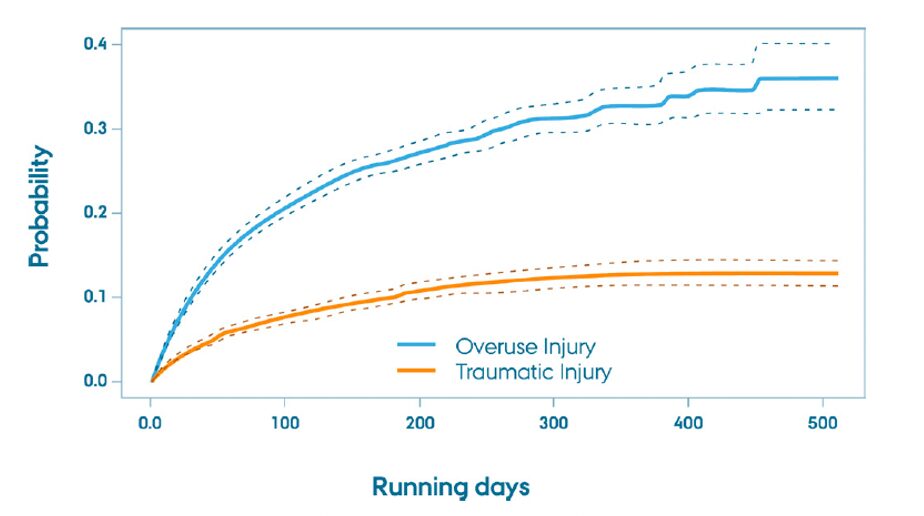
– By 200 running sessions completed, 30.5% of all people had reported an overuse injury and 12% a traumatic one (seen here in this chart)
– For the main outcome they used something called a hazard ratio. Essentially a hazard ratio of less than 1 means the outcome is less likely to occur. A hazard ratio of 0 means it is equally likely to occur and a hazard ratio over 1 means it is more likely to occur.
– Let’s focus our discussion only on overuse injuries as these are certainly the main culprit here and who can predict a traumatic one like slipping off a curb.
– As you see in the below chart, there was a substantial increase in injury risk for all changes above 10% increase.
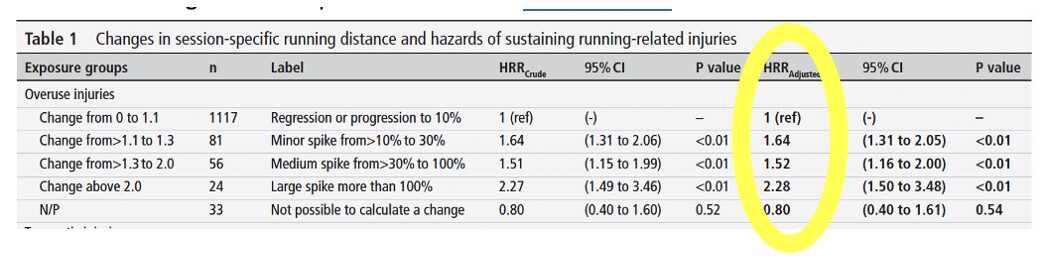
– So there was an increased risk of 64% for an overuse injury if you ran a single session 10-30% higher than any session in your prior 30 days. There was a 52% greater risk if you ran 30-100% more and unsurprisingly a full 228% increased risk if over 200% change in a single session.
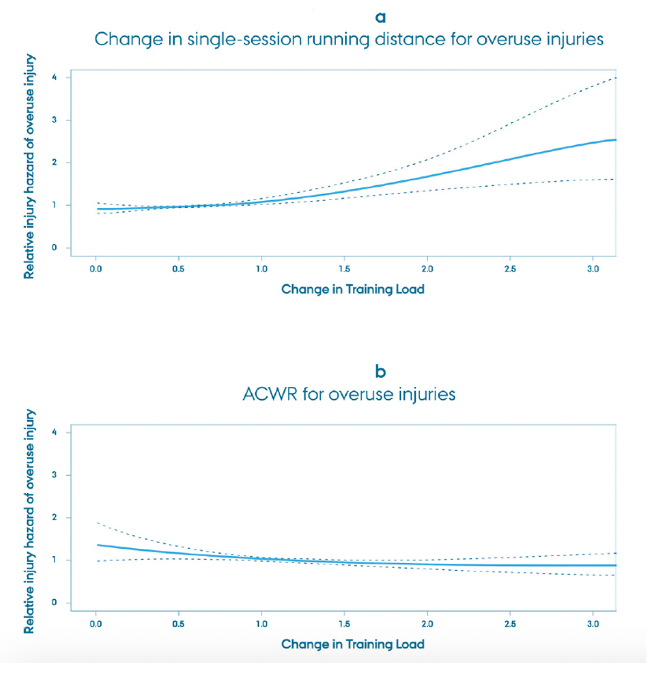
– What was equally surprising was that there were really NO DIFFERENCES to risk using the acute to chronic workload ratio which throws massive shade on something that I firmly believe in.
– Here are the risks of changes to single session run distance, versus changes in total training load as defined by the acute to chronic work ratio in 2 simple graphs:
So what have we learned?
1) Maybe most injuries actually occur due to an excessive training load in a SINGLE SESSION versus a gradual increase over time.
2) You should avoid running a distance in any current session that exceeds 10% of the longest distance you covered in the prior 30 days.
3) There is some risk up to 10% but not as high. The data showed a 19% increased risk by increased single session distance of 10% versus 1%.
The question I had that is unanswered is let’s say you run 2 or 3 longer distance runs in a week or 10 days. Let’s say your longest run had been 10km in the preceding 30 days. That means you can ‘safely’ run 11km in the first longer run.
Now your new baseline is 11km for the last 30 days, but surely it doesn’t mean you can add 1.1km on the next run to then hit 12.1km.
Like many things in our world…….more research is needed!