


How much light and moderate physical activity is 1 minute of vigorous activity worth?

I’m at a stage in life right now where time is tight.
My wife and I share a calendar. Some weekends it looks like someone vomited appointments all over the screen with activities everywhere in the city to appease 3 growing kids.
That said, one thing we are not willing to give up while being so busy is exercise.
Physical activity is not just important in my family, it’s a core value.
The best way to try and get our kids to adopt healthy habits is to exhibit them ourselves.
Knowing this, I am constantly on the lookout for time efficient workouts to maximize my health benefits.
I had a discussion recently with a client where we got to wondering how much intensity actually matters. More specifically, if there was a way to quantify how much 1 minute at zone 5 (all out vigorous effort) is ‘worth’ from a health standpoint when compared to zone 2/3 (moderate intensity) or zone 1 (very light intensity).
So I went searching, and surprisingly found a very accurate answer.
This study was so good, that it was published in arguably the most important scientific journal in the world (Nature).
One topic that was pointed out in the article, is that the current WHO physical activity guidelines to get 15-300 minutes of moderately intense physical activity (MPA) weekly, or 75-100 minutes of vigorous physical activity (VPA) or a combination of both are not actually based on good empirical studies.
Instead, these recommendations are based on self-reports (questionnaires) where people try and recall the amount of physical activity they performed and how intense it was. From these, the current weighting of 1 minute of intense vigorous activity equals 2 minutes of moderate intensity was born.
There are lots of studies showing a dose response in activity meaning that the higher intensity with which you exercise, the risk of long term diseases and all cause mortality is lowered. The problem with these studies though is that many are based on this 1 minute of vigorous activity is the equivalent to 2 minutes of moderate activity (which is flawed).
Additionally, no one has ever mentioned light physical activity (even in the physical activity guidelines).
And what of our wearables? Does my apple watch give me enough credit if I am sprint racing my 7 year old?
Turns out probably not. Though many of the tech company algorithms are kept secret, an example the article gives is that Google Fit assigns Heart Points based on your hear rate intensity during exercise. It gives a 1 if you are exercising at a moderate amount (over 100 steps in a minute) and a 2 if they deem it ‘vigorous’ over 100 steps in a minute.
But are these numbers arbitrary?
Probably.
To really test this, we need a more accurate study using a wearable device to actually track exercise intensity and the study has to be prospective to actually determine how these people fared over time.
Lucky for us, this study did just that.
They utilized the UK biobank and gave 103,684 people a wearable wrist worn accelerometer to measure activity for 7 days.
They then used a validated 2 stage machine learnings based intensity classification scheme to measure the actual equivalence of light and moderate intensity against each minute of vigorous activity against a variety of important health outcomes like all cause mortality, cardiometabolic events and cancer.
They followed these people for 8 full years to see if any developed health issues. The total sample ended up being 73,485 people and there were 2675 all cause mortality events. The mean age of the population was 61 years old.
Check out the chart below.
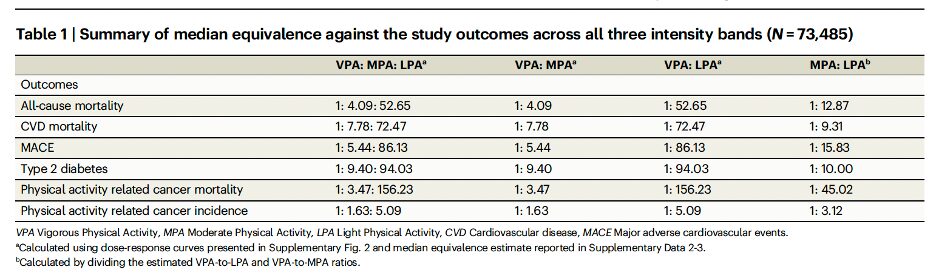
There’s a fair bit to unpack here but the take home points are as follows:
- 1 minute of vigorous intensity physical activity was equal to:
- 1 minutes of moderate activity for all cause mortality
- 8 minutes of moderate activity for cardiovascular disease mortality
- 4 minutes of moderate activity for major adverse cardiovascular events
- 3 minutes of moderate activity for type 2 diabetes
- 47 minutes of moderate activity for cancer related mortality.
- 1 minute of vigorous intensity physical activity was equal to:
- 65 minutes of light activity for all cause mortality
- 47 minutes of light activity for cardiovascular disease mortality
- 03 minutes of light activity for type 2 diabetes
- 23 minutes of light activity for cancer related mortality.
This is very specific.
Let’s take a step back and come up with a couple of points you can hang your respective hats on.
First, it seems that BOTH vigorous and moderate physical activity had favourable dose response associations across all negative outcomes while light activity had just slight risk reduction and this was only for Type 2 diabetes and all-cause mortality.
Vigorous activity was better than moderate activity which was better then light activity in terms of risk reduction.
To answer my clients question, each minute of vigorous activity was equal to roughly 4-9 minutes of moderate activity and 53-156 minutes of light activity in long term health outcomes.
This is an ABSOLUTELY MASSIVE departure from the 1:2 ratio that seems to have been adopted everywhere including wearable fitness devices and even the World Health Organization.
When they looked at the data, it also became apparent that people WAY underestimate how much light physical activity they do. Walk to grocery shop? That’s light physical activity. Have to get from the go train to your office building? Light activity.
We also tend to overestimate our moderate activity.
What we really need to do is include more 10-60 second vigorous activity bursts through the day. These all add up! Vigorous activity does NOT have to mean a 20 minute hard interval session.
It can mean climbing 2 sets of stairs quickly each time you have to change floors.
Or spend even 10 minutes with my hyperactive 7 year old!
Final summary: Any way you can increase your heart rate for even short periods your are doing your future self a massive favor.