


Do you need weights to rehab your low back?
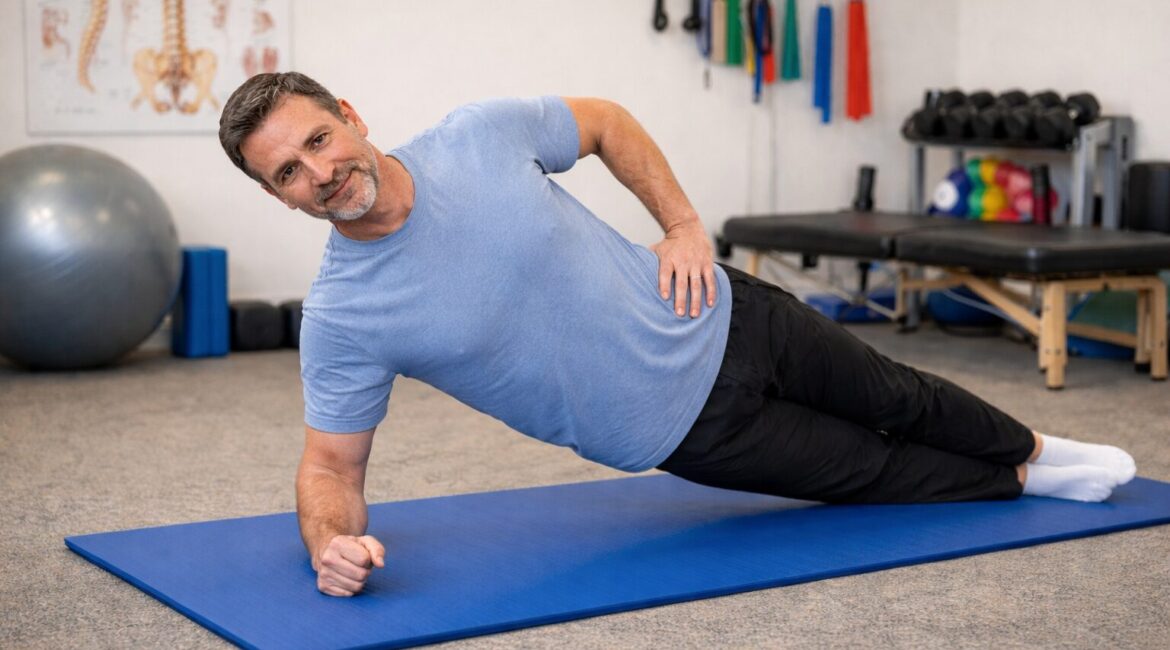
As a rehab based clinic low back pain is one of, if not THE most common condition we see.
Back pain can be classified many ways, but researchers now like to use umbrella terms to encompass the large majority of low back pain that is not scary in nature, meaning not from pressure on a nerve sending pain down your leg, a fracture, or other problematic condition.
Nowadays, the ‘preferred’ term is chronic non-specific low back pain and at any given instance it is estimated there are 540 MILLION people worldwide affected by it.
We put rehab exercises at the base of the pyramid for best evidenced care regardless of what condition you are dealing with.
Tennis elbow? Exercises
Achilles tendon? Exercises
Chronic back pain? Exercises
Kids bugging you from an unexpected snow day (like today)? Exer…..can’t really help you there.
People that have a history of gym based workouts are often surprised when we start the large majority of low back pain patients with exercises that have no external load (meaning no external weights added to their exercises).
We often do progress to exercises with weights in the gym……but not in every case.
Confused?
Well at our clinic one of our main values is individualized, tailored care. We despise clinics with cookie cutter handouts for any type of condition as they do not address the stage of healing you may be in, let alone your experience with exercises, your attitudes and beliefs about rehab, or any other contextual implications to your recovery.
We have some general ideas that we follow in terms of progressing people, largely guided by people’s pain levels and expected tissue adaptations.
But to be clear: If you are doing the same exercises you were 6 or 12 weeks ago, we have failed.
This means that sometimes rehab is a bit more of an art then a science.
Sometimes we use weights and sometimes we don’t.
This begs the obvious question, are weights better than body weight for chronic non-specific low back pain (which makes up over 80% of ‘everday’ low back pain)?
Well a systematic review and meta-analysis recently looked at all past studies that address this question, pooled the results for us and gave us some interesting guidelines and answers.
Generally, we tend to side with external loads for many conditions. We know it results in better strength gains increasing tissue capacity. It increases cartilage turnover and there’s even research showing exercising with weights improves your responses to pain by increasing your pain threshold.
We also like that you can do graded exposure by slowly increasing the amount of weight you add at any given time.
Simply put the only way we can ask a tissue to adapt is by challenging it with added work.
The back is different.
It is a symphony of insanely complex tissues with a multitude of pain generators. You also can’t exactly ‘rest’ your back as it’s loaded with everything you ever do including sitting and standing!
Often, just your body weight (or at times even less than that) is all that is needed to ask back tissue to adapt and hopefully decrease your pain.
This meta analysis grouped 778 patients with non specific low back pain where roughly half did a resistance training program using external loads, and the other half used just movements and body weight.
The typical program was 8 weeks long, and 3 times weekly for the program.
Here is what the researchers found:
Overall, external loads may promote measurable neuromuscular adaptations but these benefits DO NOT consistently translate into better outcomes in either pain or disability nor have any advantages on psychological variables like fear avoidance and catastrophizing.
What does this mean?
Generally it means that external loads can be a USEFUL tool but in no way a universally necessary one.
It turns out that clinical outcomes for those with chronic low back pain depend more on how your exercise program is structured, delivered and interpreted than on the intensity of the exercise and how much weight you are using in your rehab.
The DELIVERY of exercise is likely more impactful than it’s intensity or volume.
HINT – THIS MEANS THE QUALITY OF THERAPIST IS KEY!
When you look at the data from this study, the researchers suggest instead of high intensity, they believe that exposure consistency and volume are more important. This means low intensity and high frequency strategies are the best.
See our past blogs on both walking, and exercise snacks as examples.
So next time your back is sore, added weight may not be important…..or it may be! What’s really important is finding a good therapist to help guide you on your path to recovery.
To sum up this entire article:
Exercise works, but how it is delivered matters more than how heavy it is!