


Does physical activity actually change your mood?
Dr. Eric Topol is an American Physician-Scientist that tends to offer a balanced, trusted and well-evidenced perspective on difficult medical topics. He is someone that can take complex topics and research and narrow down the message into an easy to understand short explanation. He is also not scared to dissent on opinions he does not agree with. He even teamed up with our latest speaker Dr. Stuart Phillips to go after what Dr. Phillips called ‘charlatans’ that are espousing outrageous amounts of protein intake well in excess of what the research suggests is optimal.
Dr. Topol just highlighted an article that was just published today (May 6, 2026) that really caught my attention.
The Nature Journal is considered the holy grail scientific journal that all researchers try to get published in. When Nature deems an article to be of particular importance, they will make it open access, removing the paywall for the greater good.
This was one of those articles.
To absolutely nobodies surprise, lots of prior studies have shown that both diet and physical activity levels can have a major impact on your ‘affective well-being’, essentially meaning how you are feeling emotionally.
These prior studies tend to have lots of flaws. They are almost always ‘retrospective’ meaning they use surveys to ask people how they felt or how much they exercised over a given period. These surveys tend to be terribly inaccurate and skew results. On top of that, to ‘standardize’ studies, the physical activity sessions are usually in a lab setting which hardly mirrors a nice walk in nature.
With technological advances, associations like physical activity and your emotional well being are now much easier to accurately quantify. Have someone be prompted to complete a quick smartphone survey at regular intervals and have them wear an accelerometer to track how much physical activity they are actually completing and voila! You’ve greatly improved your dataset to draw conclusions.
That is essentially what this article sought to answer: How does physical activity relate to your affective well being in everyday life.
The researchers took other studies and pooled 67 datasets from 321,345 participants that all used smartphone based affective wellness ratings and contributed to roughly 1 MILLION hours of accelerometer data.
This allowed them to establish a number of previously unknown answers:
- How does your mood change BEFORE exercise versus after?
- Is it different between genders?
- What about age?
- Does what level of shape you are in to begin with matter?
- What aspects of affective wellness are changed – is it increased energy? Is it emotional well being? What about calmness?
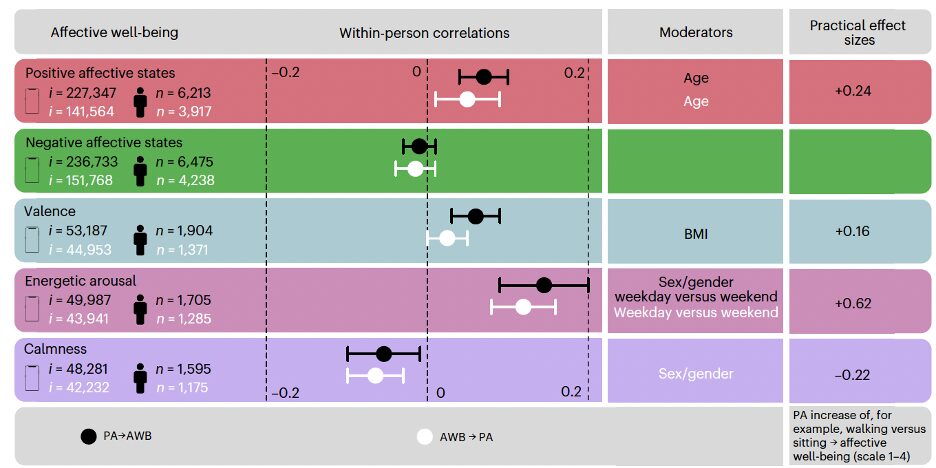
Here is a little graph from the article to look at prior to summarizing the results. The middle section with the lines with dots that look like drone planes from star wars tell whether physical activity was associated with particular variables. If the drone plane is to the right of the vertical line then physical activity helped. If it was to the left then it actually made it worse.
To summarize the study findings:
- The researchers were able to show that in everyday life, physical activity is associated with the following within a person:
- Valence (a feeling of goodness)
- Energetic arousal
- Positive affective states
- These occurred if the person took the phone survey either before OR after exercising.
- These changes were there even if a person just went for a walk instead of continuing to sit!
- They were also able to show that in everyday life, if someone had a higher affective wellness score, then they did more physical activity and vice versa. This means that the emotional side of things and exercise play off one another. Those with higher affective wellness scores did more physical activity.
- Some factors did impact these scores:
- The findings were less pronounced in older folks when compared to younger people.
- Women felt more energetically aroused after being physically active then men.
- Those with a higher body mass index had a lower affective wellness score after and before exercise. The researchers think this is potentially attributed to feelings of discomfort, pain, heat etc.
- The finding was stronger on weekends versus weekdays……work sucks!
Why is this important?
This paper started with an absolute banger of a statistic. If people met the current WHO physical activity requirements, GDP would increase by USD $314 to $446 billion a year. The reason is twofold. First, it would counteract many physical ailments that cause people to miss work, and equally as important, it is now shown to have the ability to decrease days missed due to mental illness.
If you want more evidence as to the importance of exercise and mental health, Dr. Topol also linked to this 2024 mega article that showed that all forms of physical activity were superior to SSRI drugs for depression.