


The Science of Blood Flow Restriction: Can REALLY LIGHT Weights Build Serious Muscle?
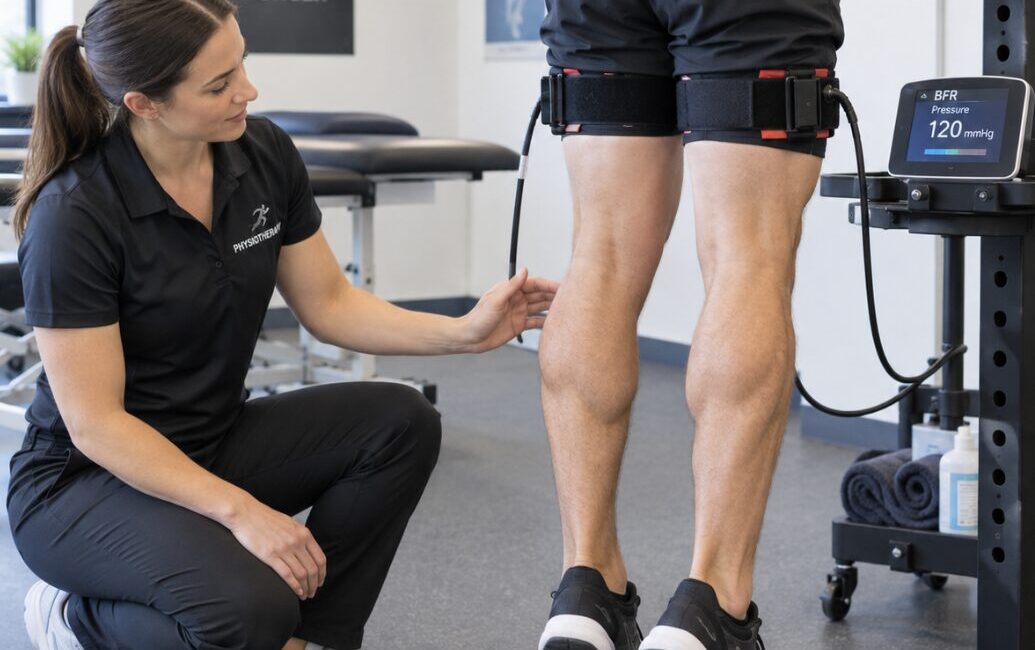
What if you could get a surprisingly powerful muscle-building stimulus from a weight that normally wouldn’t seem heavy enough to matter?
No this is not the latest ‘shake weight to get ripped’ or ‘Dr. Ho belt for a six pack’ gimmick.
The use of blood flow restriction (BFR) has become an increasingly well-supported tool in both exercise science and rehabilitation and new research published in 2026 is helping clarify where and how it can be helpful.
So, what is BFR?
BFR involves placing a specialized cuff around a limb, usually close to the hip or shoulder, and partially restricting blood flow to that extremity while performing an exercise. Even using very light loads the exercise can feel extremely difficult.
Why does a light weight feel so intense, so quickly? Restricting venous blood flow causes metabolites to accumulate in the working muscle and increases the recruitment of muscle fibres as fatigue develops. The net effect is that using BFL can create a surprisingly large training stimulus without the need for using heavy weights.
Can light weights really build muscle?
Increasingly, the answer appears to be yes.
And if you’ve read our content over the past decade you know that Dr. Brad Schoenfeld and colleagues have shown that muscle hypertrophy can be achieved across a remarkably wide spectrum of rep ranges (from 3+ to 30 reps per set) provided that the effort or tension is high enough to take a set close to failure.
But with BFR we are talking VERY light weights. Typically 20-30% of a 1RM max, whereas even 40-60% of a 1RM max would be considered light weight in Schoenfeld and colleagues work.
A 2026 systematic review and meta-analysis in the British Journal of Sports Medicine examined BFR in people with musculoskeletal conditions. Compared with the same low-load exercise without BFR, low-load BFR produced greater improvements in muscle strength and disability. However, BFR did not clearly outperform conventional high-load resistance training.
And that’s an important distinction.
BFR isn’t necessarily better than heavy lifting or likely even moderate lifting at higher reps, it’s simply a way of creating a meaningful training stimulus when typical loading protocols are not practical or possible.
Where does BFR become particularly interesting?
Imagine someone recovering from knee, ankle, elbow or wrist surgery. Or maybe they just got out of a cast or boot being immobilized for an extended period of time. There may be significant atrophy, pain or other restrictions to safely perform a traditional rehabilitation exercise like a squat, push or pull exercise.
Simple movements with BFR such as knee extension, elbow flexion or hand gripping can potentially allow a light exercise to provide a much stronger stimulus for maintaining or rebuilding muscle.
A good example of a clinical application for BFR is early in the ACL rehabilitation (1-12 weeks). During this early period there is a need to protect the healing graft and knee joint by avoiding heavy loads. But this is also a period of significant quadriceps atrophy. Many patients are experiencing high levels of pain and swelling during this period so the notion of any challenging exercises can be a major barrier. BFR can help combat that quad atrophy and improve early ACL rehabilitation results using simple movements such as a quad squeeze or a partial knee extension.
Some other clinical applications for BFR include: Total knee arthroplasty (knee replacements), meniscus repairs, knee or ankle osteoarthritis, patellofemoral pain syndrome, achilles tendonopathy or tears, patellar tendinopathy, wrist and elbow surgery and elbow tendon issues.
Because the blood flow cuff is applied in the upper leg and arm (past the shoulder and hip joints), typically BFR is used less often with hip and shoulder issues. However, when there is distal muscle loss from a hip replacement or rotator cuff surgery for example BFR might be a reasonable option to help combat that peripheral muscle loss.
What about for regular fitness or athletic training in subjects that are not injured?
Here’s where there is some nuance to the BFR story.
A 2026 meta-analysis involving 859 team-sport athletes found that adding BFR to resistance training produced small improvements in muscle hypertrophy and strength, but did not significantly improve sprint or jumping performance.
That’s a valuable lesson, but not really a surprising one. Building more muscle doesn’t automatically make you more athletic. You still have to train the specific qualities you want to express as an athlete.
Just like lifting light weights with high reps and high challenge can build muscle, that style of training won’t win you any powerlifting competitions.
So should everyone start training with BFR?
Not necessarily.
For someone who can comfortably perform progressive, heavy resistance training, there is no compelling reason to abandon it. Moderate to heavy resistance remains one of the most effective ways to build muscle and develop maximal strength.
Where BFR gets particularly interesting is when the amount of weight you can lift is the limiting factor.
Think of it as a one tool in your strength training toolbox.
And that’s where exercise science and physiotherapy converge. BFR can help get a more meaningful muscular stimulus when you can’t lift heavy.
At The Proactive Athlete, BFR is one of the tools we can use when the goal is to progressively rebuild strength and muscle while respecting an individual’s current capacity.