


How rapidly do we actually decline as we age?
I remember back in university learning that we lose a certain amount of strength, power and aerobic capacity as we age. Back then I was taught we start losing strength at a cadence of about 1% a year starting around age 40. This becomes clinically relevant in our 6th and 7th decades when this loss of physical capacity can cause falls and other catastrophic consequences.
Back then I never questioned the sources of anything I learned so took this linear strength loss as gospel.
A recent fascinating study actually gave us credible evidence that the RATE at which we lose aerobic capacity, muscle endurance and power as we go through life is actually not a straight line down at all.
And MUCH MORE IMPORTANTLY it is the first study ever to show us that there is indeed something we can do about it!
This study started way back in 1974 where researchers chose a random set of 427 sixteen year old school pupils in Sweden and put them through a variety of physical tests. The cool part of this study is that they re-did these tests on these folks at ages 27, 34, 52 and now 63 (they will continue to test them as they age).
They performed BMI, strength tests via handgrip dynamometer (like in our waiting room here at our clinic), and sit to stand tests from a chair, a submaximal aerobic clinical cycle test, a repeated bench press test for endurance, and a Vertical Jump test (the Sargent Jump Test) for muscle power.
We already know that no matter what we lose features of our athletic ability as we age. This is well established even in elite athletes.
So what were the pertinent results from this really cool study?
– At age 63, 8% of the participants had passed away.
– The participants BMI increased primarily from ages 16-50 with a faster increase in men between ages 30 and 50.
– At 16 men were slightly more active in their leisure time but women caught up to this by age 34.
Aerobic Capacity:
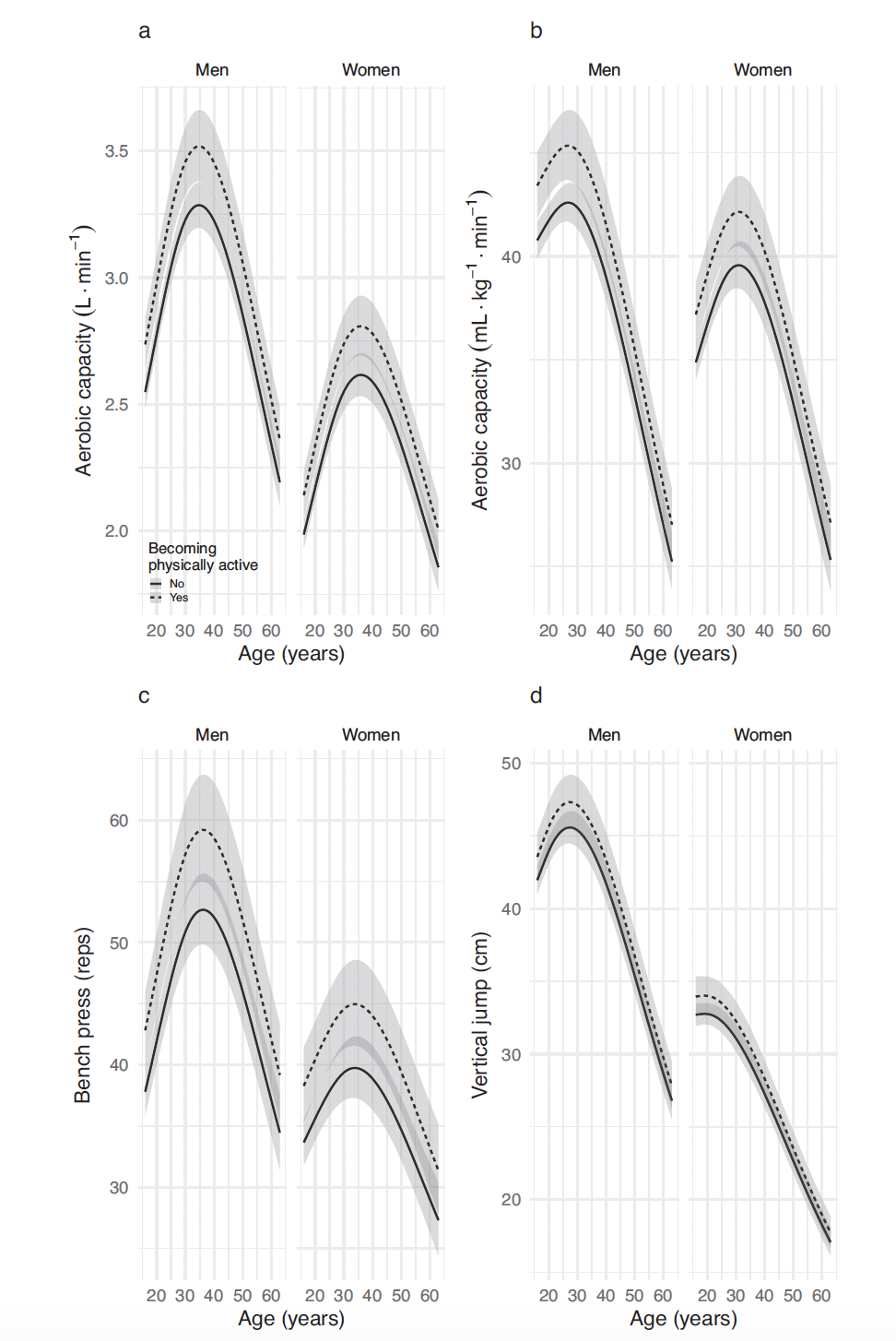
– Men had a higher aerobic capacity throughout their adult life. The peak age of performance was 35 in women and 36 in men. The rate of decline after age 45 was the same for men and women.
– The decline accelerates from age 40 through to age 63 where total decline was 30% in women and 33% in men. From their peak at mid thirties the decline was 37% in women and 40% in men.
– Interestingly people that were more active in their leisure time at age 16 had a higher aerobic capacity (both relative and absolute), muscle endurance and muscle power in adulthood.
Muscle endurance:
– The age of peak performance was 34 for women and 36 for men. The rate of decline was the same from age 40-63 however the KEY FINDING is the rate of decline. This one starts very light (just 0.4% a year), however by age 63 study participants were losing 2.3% PER YEAR of muscular endurance.
Muscle Power:
– This one did show a sex difference where men peaked at age 27 and women at age 19.
– By age 63 power showed a 48% decline in women after age 44 and 41% in men!!!!!!
So what have we learned?
If I could summarize the study it would be that peak capacity seems to be reached before age 36 in all measures and after 40 there were similar and accelerating decreases in all tests for both sexes.
The key though was how rapidly the decrease happens. For about a decade after peak, the annual decrease for all measures was well under 1% per year. However by age 50 this increased to OVER 2%!
In fact, by age 63, both sexes only had about 65% of their peak capacity they had in their mid 30’s for most measures. The worse was power where women maintained just half of their peak capacity and men just 60%.
Now for the good news!
Enough bad stuff. The good news was that at any age, switching from a physically inactive to an active lifestyle increased physical capacity in ALL TESTS by 6-7% for aerobic capacity, 11% for muscle endurance and 4% for the vertical jump.
The other key to this study was showing how important it is to stay active throughout your life. The researchers were able to compare this data to masters athletes. Essentially, staying active throughout life dramatically delays the rate of decline for all measures.
By how much?
The declines seen at age 63 were not seen in masters athletes until age 75!!! That is absolutely massive from a healthy aging and more importantly safety perspective.
This may just be the first study that has shown prospectively that transitioning from physical inactivity to a physically active lifestyle AT ANY AGE improves performance in most fitness modalities. This means early inactivity DOES NOT mean irreversible impairment in physical performance. You can have measurable improvements even in the last decades of your life!
We will conclude with a sentence that really hit home from the paper:
“Physical activity consistently emerges as the most important factor influencing both absolute physical capacity and rate of age-related decline.”
So go out and start exercising!