


What’s better for diabesity? Aerobic or resistance training? Also, what is diabesity?
Every few years an attention grabbing research title will scroll across the news wire comparing aerobic exercise to resistance training and their respective effectiveness on body composition, muscle mass, cardiorespiratory health and other health metrics.
Yes, we love to pit runners against gym bros in a one size fits all health economy where each will claim superiority over the other.
The main point that Dr. Stu Philips continually pounded out during his lecture to our clients this spring was that the best form of exercise is the one that you enjoy the most!
So when yet another giant study comparing aerobic exercise with resistance training just got published to much fanfare, I can admit I started to leaf through it with a bit of a narrow view, expecting to learn nothing.
I was pleasantly surprised at the change in tone of the recommendations made by the researchers.
This was a massive study looking at the effectiveness of both aerobic health and resistance training on many health factors with one catch.
This large meta-analysis only included people with diabesity.
That immediately begs the question…….what the heck is diabesity???
Well the article notes that in 2021 alone, cardiovascular disease and type 2 diabetes combined for over 20 million deaths. This can no longer be called an issue, it is now considered a full blown obesity related epidemic.
Cardiovascular disease and type 2 diabetes share a lot of common features: high blood pressure, dyslipidemia (issues with your fat levels), impaired fasting glucose, insulin resistance and many more.
Researchers are now starting to take a step back and look at what are called ‘network models’ of disease where they acknowledge the complexity of these conditions and grouping them together allows for us to make scalable lifestyle interventions to impact more conditions.
This was the birth of the term ‘diabesity’ which links insulin resistance, impaired glycemic control, fat deposition throughout the body, fatty tissue chronic inflammation and chronic low grade systemic inflammation.
Recommendations for one disease are likely to be very impactful on the other. This makes a ton of sense.
The issue is that all clinicians know that diabesity carries huge risks but they are not sure which to emphasize between aerobic exercise and resistance training.
If someone comes in severely overweights, many doctors will suggest biking a number of times a week, however this may ignore the benefits of resistance training for folks with type 2 diabetes like maintaining skeletal muscle mass which is a key factor in insulin sensitivity.
The other issue is that most prior meta-analysis where they group trials together to draw out conclusions, tend to compare aerobic exercise with non-exercise or ‘usual care’. Same with resistance training. They rarely compare one against the other.
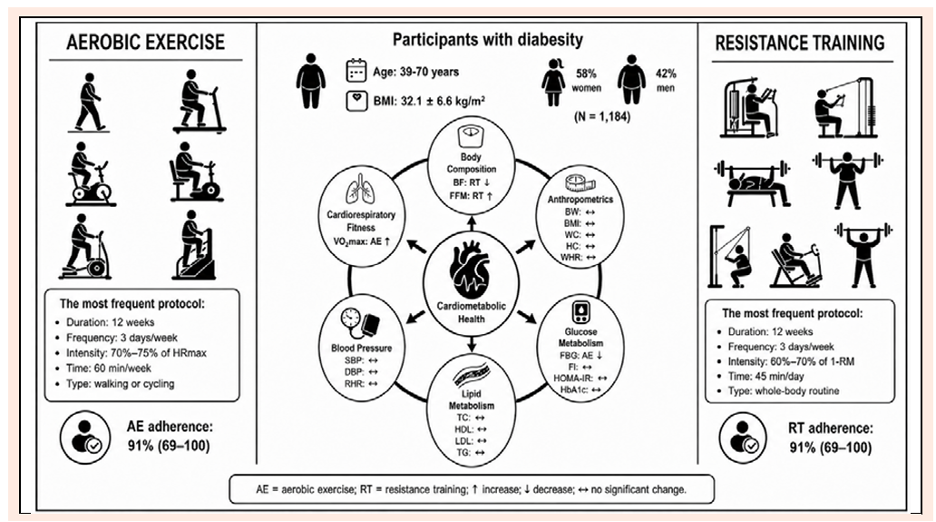
After a ton of exclusion criteria this trial ended up including 1,184 trial participants across 23 studies. The mean BMI in the group was 32.1.
This graphic summarizes the study findings (we will break them down below):
A simple summary:
– Aerobic training was better for fasting blood glucose and cardiorespiratory fitness
– Resistance training for body fat and free fat mass
– There was no difference between the two for an astounding number of factors including body weight, body mass index, HbA1c, lipid markets and many others.
Overall this is yet another study showing that both aerobic training and resistance training should likely be combined. However, researchers are starting to recognize that there should be no one size fits all program for folks struggling with weight.
Let’s say someone was trying to lose weight and had just started a GLP-1. Perhaps the dominant treatment target is to stop muscle loss (sarcopenia) while they lose weight. Then an emphasis on resistance training should likely be at the forefront.
Let’s say that a person’s blood work showed that glucose metabolism issues are the primary goal. Well aerobics may be a better emphasis here.
Overall the concluding sentence does a good job of summarizing the findings:
“When interpreted within lifestyle medicine paradigm, these complementary findings support a goal directed and individualized approach to exercise prescription rather than a one modality fits all model.”
Like Dr. Phillips said……you’re best exercise is the one that you enjoy the most!