


You Don’t Need to Run a Marathon to Improve Your Heart Health: The Simple Power of Isometric Exercise
What if improving your cardiovascular health didn’t require expensive equipment, a massive time commitment or even breaking a sweat? A growing body of research suggests that a few minutes of surprisingly simple exercise could make a meaningful difference to your blood pressure and subsequent overall cardiovascular health.
I have a long-term patient who struggles with exercise motivation. He’s overweight, has high blood pressure and bloodwork findings consistent with metabolic dysfunction. He also has persistent back pain that makes walking difficult, and his favourite activity, golfing, will consistently aggravate it.
He’s on his feet all day at work, feels self-conscious about his current fitness and finds the thought of going to a gym overwhelming. He’s making gradual changes to his diet, but improving his overall health is proving to be a slow process.
We can manage his back pain with treatment, but he understands that meaningful, lasting improvements will likely require changes beyond the treatment room.
And that’s the challenge: how do you encourage someone to exercise when many of the suggested activities make them feel worse or seem unfeasible.
Many of you might not share his particular struggles, but chances are you know someone who does. Please pass this message on to someone who needs it.
Exercise doesn’t have to be complicated
In 2025, we welcomed Dr. Martin Gibala to our facility to speak about the concept of exercise snacks: short bursts of random physical activity built into your everyday routine. A little extra power push up those stairs, turning a walk into a jog to catch the bus or doing a set of squats between meetings or while taking a call. In the research world his colleagues call this vigorous intermittent lifestyle physical activity (VILPA).
Research suggests that just three or four one minute bursts of vigorous activity throughout the day can improve cardiovascular fitness and yes, bigger picture: longevity.
These moderate to higher intensity exercise snacks are great. It’s a message we highly encourage for anyone who is strapped for time and wouldn’t otherwise exercise. But even those short bursts of vigorous exercise can be intimidating or not possible for someone with a complex array of health issues.
That’s why some recent research on isometric exercise caught my attention.
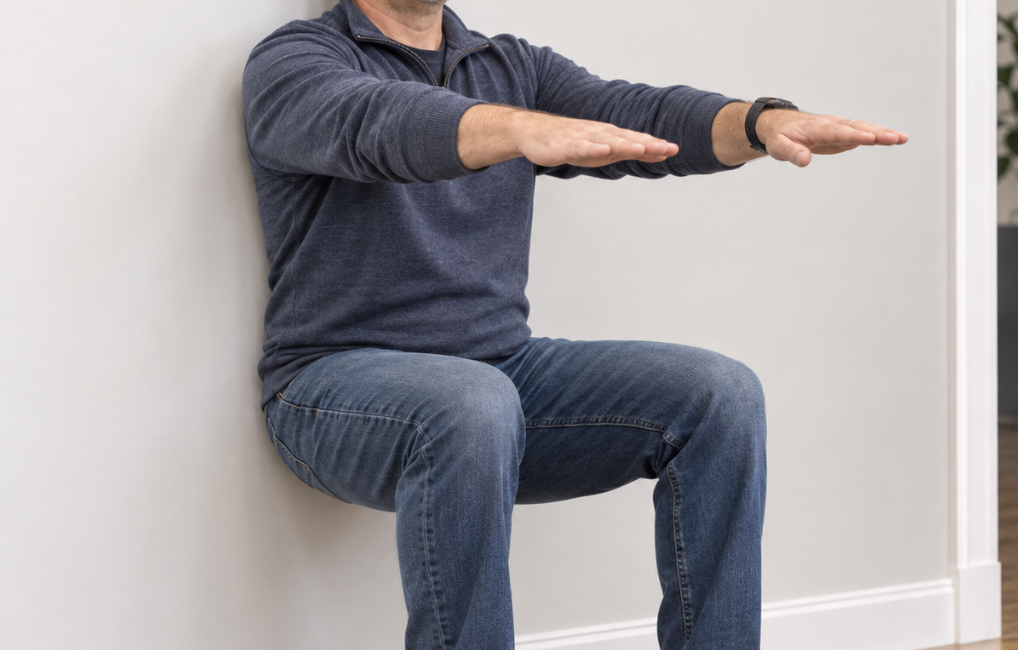
What if something as simple as sitting against a wall and holding a squat position for a couple of minutes or squeezing a grip strength device could move the needle on your cardiovascular health?
It sounds too simple. And it’s definitely not sexy enough to generate views on instagram or tic tok. But the mounting research on isometric exercise and benefits for your blood pressure is very compelling.
Isometrics and blood pressure: What does the research show?
Isometric exercise involves contracting your muscles without actually moving your joints. Think wall sits, static lunges, planks or squeezing a handgrip device.
A March 2026 systematic review and meta-analysis in Frontiers in Public Health examined 40 randomized controlled trials.
The researchers found average reductions of 6.62 mmHg in systolic blood pressure (the top number) and 2.63 mmHg in diastolic blood pressure (the bottom number).
Wall squats performed three times weekly for more than eight weeks appeared particularly effective. A common protocol utilized was a 2 minute wall squat with a 2 minute rest between efforts, with 4 total wall squat sets completing a single session.
A systolic reduction of around 5 mmHg is clinically significant when considering long-term cardiovascular risk. So we aren’t talking about some measured change with no real life meaningful effect.
A second meta-analysis, published in the Journal of Clinical Hypertension in April 2026 , examined 31 studies involving 905 participants performing isometric handgrip exercises.
Average blood pressure reductions were 5.38 mmHg systolic and 2.71 mmHg diastolic. Again meaningful cardiovascular changes.
The proposed training protocol involved four two-minute contractions at approximately 30% or more of maximum grip strength, three times weekly for 8 weeks.
For many people just getting started, we need to know how little is enough and these two meta-analysis both show as little as 24 minutes of effort a week is enough for a meaningful change in cardiovascular health.
And is 8 weeks required? Or is 4 weeks sufficient? What about the required maintenance after that?
A recent study in BMJ Open Sport & Exercise Medicine in September 2026 tackled these important questions.
Researchers recruited 100 adults and initially had them complete four weeks of wall squats three times weekly. Participants were then divided into groups exercising three, two, one or zero times per week.
After the initial four weeks, average blood pressure reductions were huge: 9.45 mmHg systolic and 5.47 mmHg diastolic.
Over the following four weeks, those who continued exercising maintained much of their improvement. Even those exercising just once weekly retained some benefit, although three sessions produced the greatest overall reduction.
Those who stopped exercising experienced a reversal of much of their improvement.
The takeaway? As little as 4 weeks of 3 sessions a week of isometric exercise can make a huge change. And although consistency matters, even a reduced exercise schedule is better than abandoning it altogether after the initial 4 weeks.
Sure 8 weeks is better than 4 weeks. Researchers suspect the initial 4 weeks are functional changes in blood pressure whereas 8-12 weeks can make structural changes to the vessels themselves. But like many areas of training, anything is better than nothing and maintenance is less of a time commitment than creating the initial change.
So, where do you start?
You don’t need to replicate a research protocol perfectly. Here’s a simple starting point:
Wall sits
- Hold a comfortable squat position against a wall for up to 2 minutes.
- Repeat four times, resting between holds.
- Aim for three sessions per week.
- Start with shorter, easier holds (the deeper the knee bend the harder it will be) and gradually build up.
Simple does not mean easy. The research protocols used reasonably demanding contractions. Two-minute holds will be challenging, but you don’t need to force a deep squat or push through pain. Keep breathing throughout rather than holding your breath.
And if your hips, knees or ankles don’t allow for a wall sit, get a grip strength device. You can buy them cheap. Figure out what your maximum grip is and generate a force of approximately 30% of your max. Hold that for 2 minutes. Again 4 rounds of grip strength holds has shown to make a difference when done 3 times a week for as little as 4 weeks.
Sometimes the simplest approach is the best place to start
I’m not suggesting that wall sits replace walking, cycling, running or traditional resistance training. Those activities offer a much broader range of health benefits.
But improving cardiovascular health doesn’t have to be an all-or-nothing proposition. Isometric exercise offers an option: something accessible, inexpensive and relatively easy to fit into a busy day. Just like Dr. Gibala and colleagues VILPA research, some strategic bursts of random exercise built into your day is better than nothing.
For my patient, this isometric data offers a worthwhile starting point. A manageable activity he can build into his week. It won’t solve all his health challenges, but it might help him take that first step.
And sometimes the best exercise program isn’t the most sophisticated one. It’s the one that gets you moving in the right direction.