


How exercising affects Mounjaro prescription
One of our favourite researchers Dr. Stu Phillips from McMaster university (who we had out for a presentation to our clients in the spring) recently called a brand new research article an “incredible paper” which in the research world is like winning the Superbowl.
Immediately this caught my eye.
Then I noticed it was published in the most prestigious research journal in existence (Nature).
Now I was intrigued.
Then I saw it was a study on Trizepatide (Mounjaro), part of the GLP-1 drug class, and the effects of exercise to try and lower muscle mass decreases.
Now I was officially excited to read it.
In truth, we have been eagerly waiting for a study like this to come out! I’m going to make a bold call and say due to the popularity of this drug class This may be the most important paper to many people taking or considering taking these weight loss drugs!
In my lifetime I have never witnessed so much interest in a drug class as there has been for ‘incretin mimetics’. This is the fancy name for drugs that mimic the gut releasing nutrient stimulated hormones that your body would normally make on its own with the effect of managing obesity, and metabolic diseases. Though they have differing mechanisms, this class of drugs includes popular ones like Ozempic, the yet to be released Retatrutide and the drug used in this trial Mounjaro.
How popular are these drugs? Well in 2026 it is estimated that 11% of the American population are on them and the drug class is predicted to increase tenfold from 2023 to 2033.
Love them or hate them, no one can argue that these drugs work. Looking at a spattering of studies, total weight reduction has been in the range of 15-24% when taking these drugs with an accompanying loss of 25-34% in total body fat. Even better, there seems to be concentrated reduction in visceral adipose tissue and fat accumulated in bad areas like in the liver.
The one thing that these seemingly incredible results mask is their impact on muscle.
Highlighting this is that studies using DXA scans show an 11-14% loss of total body lean soft tissue mass (that is a broad category that includes muscle).
Why does this matter? Well generally the age ranges that folks start these drugs coincide with the age where we naturally begin to lose muscle mass. It’s great if we take people out of dangerous metabolic diseases, but we also do not want to risk frailty in doing so!
So how do we prevent this? Well the industry is testing muscle preserving drugs to take in conjunction with these weight loss drugs.
But what if we told you there is an easier, cheaper, safer way to potentially preserve your muscle mass that is JUST AS EFFECTIVE as any drug option?
If you haven’t guessed it’s boring old resistance training.
This beautifully simple study is so important because of how simple it was. They took 120 people over the course of 40 weeks and split them evenly. 60 took Tirzepatide (Mounjaro) at a therapeutic dose suitable for them, and the other 60 did the same thing BUT ALSO did just 3 one hour group exercise classes throughout the 40 week duration.
Then researchers looked at lots of outcomes, most importantly DXA scans to assess the difference in muscle mass between the two groups (as well as tests for strength, bloodwork, blood pressure and other important measures).
The average age of the participants was 57.7 years old and 86.7% were classified as obese (13.3% were overweight).
THE RESULTS:
To reiterate…..these drugs work.
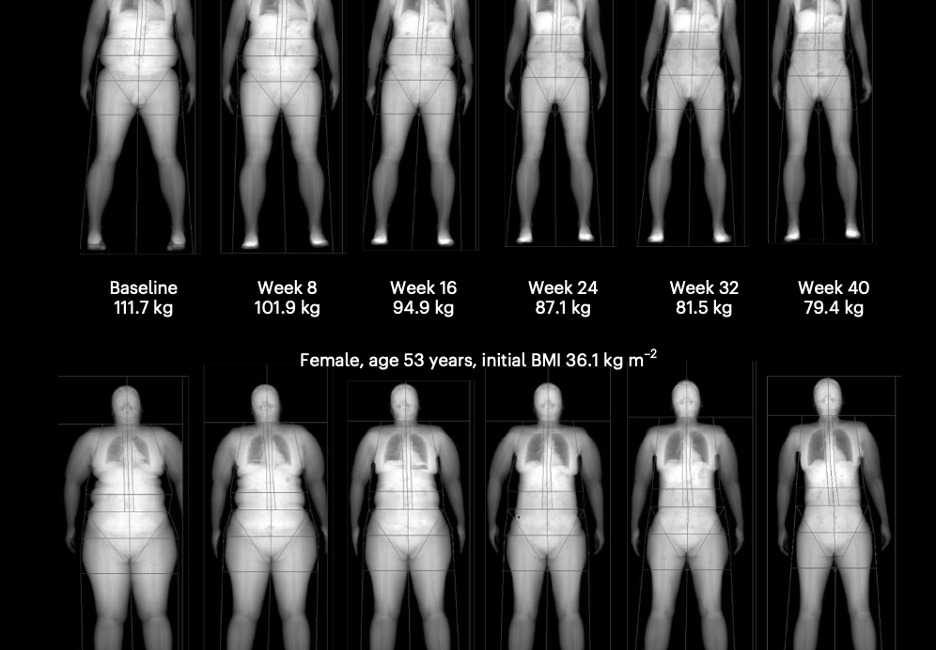
Here are DXA scans on a male (top pictures) and female (bottom pictures) participants every 8 weeks.
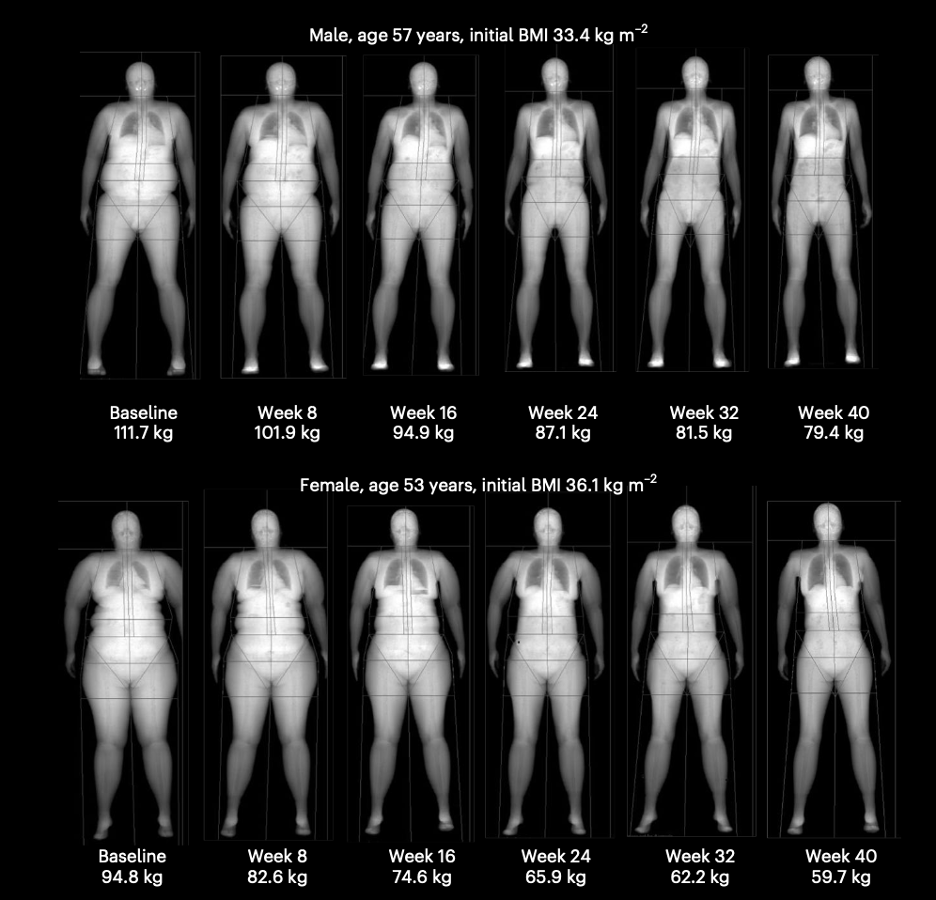
You do not need to be a Dr. to see the incredible body changes that occurred in these obese participants who by the end of the 40 weeks were no longer classified as obese.
Overall:
- Total body weight loss in both groups was similar
- Here is the nuance. There was No significant difference at the end of the 40 weeks I body fat loss between groups, BUT the exercise group had a smaller loss of total body lean soft tissue mass (this includes muscle).
- The lean soft tissue loss seemed to plateau after week 24 in both groups (More on this below).
- In the medication only group, there was a drop in strength between 6.5 to 9% in the bench press, lat pull down and knee extension.
- In the medication plus exercise group strength actually INCREASED 10-7 to 17.5%!
- Both groups had similar reductions in blood pressure, glucose, fasting insulin, HbA1C, cholesterol and triglycerides except for HDL.
What does this mean?
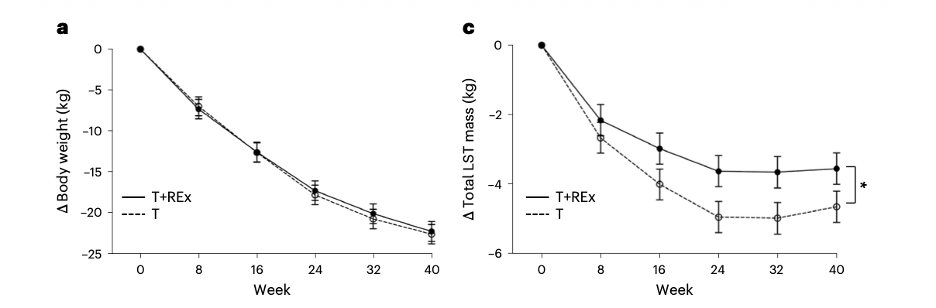
Here is a nice chart to better visualize the changes.
This shows the loss in total body weight on the left. You can see that it’s similar in both group. On the right, you notice the significant difference in soft tissue mass changes (including muscle) where those exercising just 3 hours a week lost far less. For the lean tissue loss you will also notice the plateau that happens around week 24.
Why is this important?
In general from middle age on we lose about 05-1% of lean mass per year (12-15% per decade).
These findings mean that In just 40 weeks participants lost OVER A DECADE OF AGING in terms of muscle loss!
Conversely, the 20% net gain in muscle strength shown by adding resistance training compared to the expected loss is VERY significant for long term functional implications.
The authors even made specific note that while drugs (anabolics) can help you grow muscle, that does not always equate to functional gains that only exercise provides!
Here was Dr. Phillips closing thoughts which I fully endorse:
“Resistance training goes on the same prescription as the GLP-1, as standard, for everybody who starts one of these medicines. We had good reasons to say that last week. Now there’s a randomized trial.”